Physics-based risk modeling
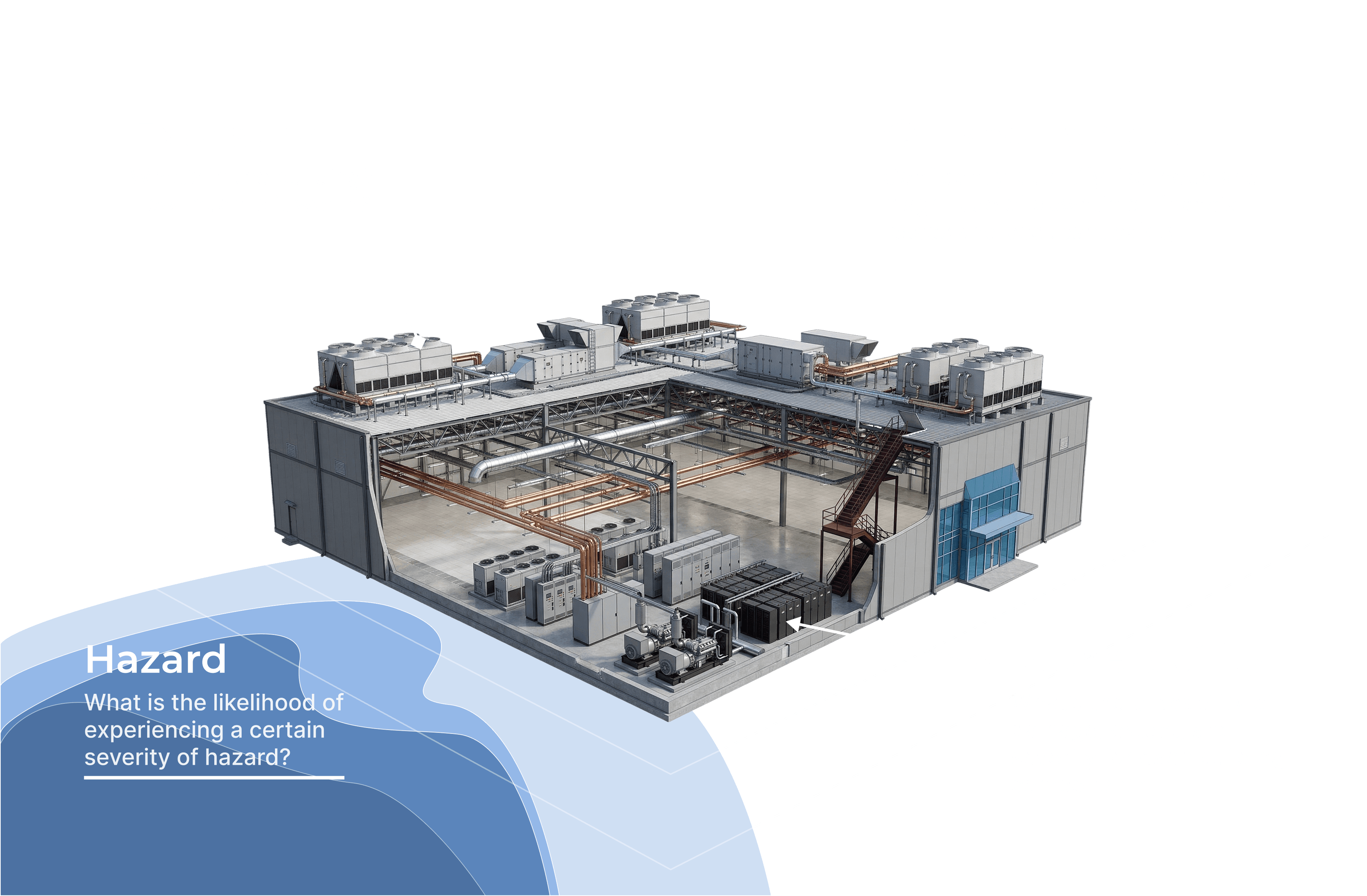
Risk is the probability of incurring a given consequence. Quantifying it requires three elements: hazard (what is likely to happen), vulnerability (how damageable is the asset), and exposure (how valuable is the asset or the service it delivers).
The intersection of the three produces consequence metrics across two dimensions:
Organizational impacts
Repair costs · Downtime / Business interruption · Revenue loss due to downtime · Combined financial losses · Inventory losses
Human impacts
Life safety (seismic only) · Health and wellness for climate-driven hazards · Heat Misery Index™ & estimated heat-induced hospitalization risk
Every metric is expressed as probabilistic distributions (10th, 50th, 90th percentiles), not single-point estimates, starting at Class 1:
return-period consequences
annualized figures (AAL, AAD)
probable maximum losses (PML)
likelihood of exceeding threshold losses
cumulative losses over holding period
Where most of the market stops at a hazard score or a single damage ratio, Iris produces the financial and operational detail that capital decisions, insurance negotiations, and resilience strategies actually require.
Iris implements a four-class assessment framework. Every class maps to explicit minimum criteria for hazard data, exposure data, vulnerability modeling, and output metrics. The same fragility and consequence functions underpin every class. What changes is the depth of input data and the resolution of the output.


At Class 3, every component is modeled individually using site-specific engineering data. At Class 1 and Class 2, Iris uses building archetypes, but these archetypes are themselves generated from component-level probabilistic models. The same fragility and consequence functions. The same engineering framework. Simplified input, not simplified methodology.
Component-level rigor and traceability
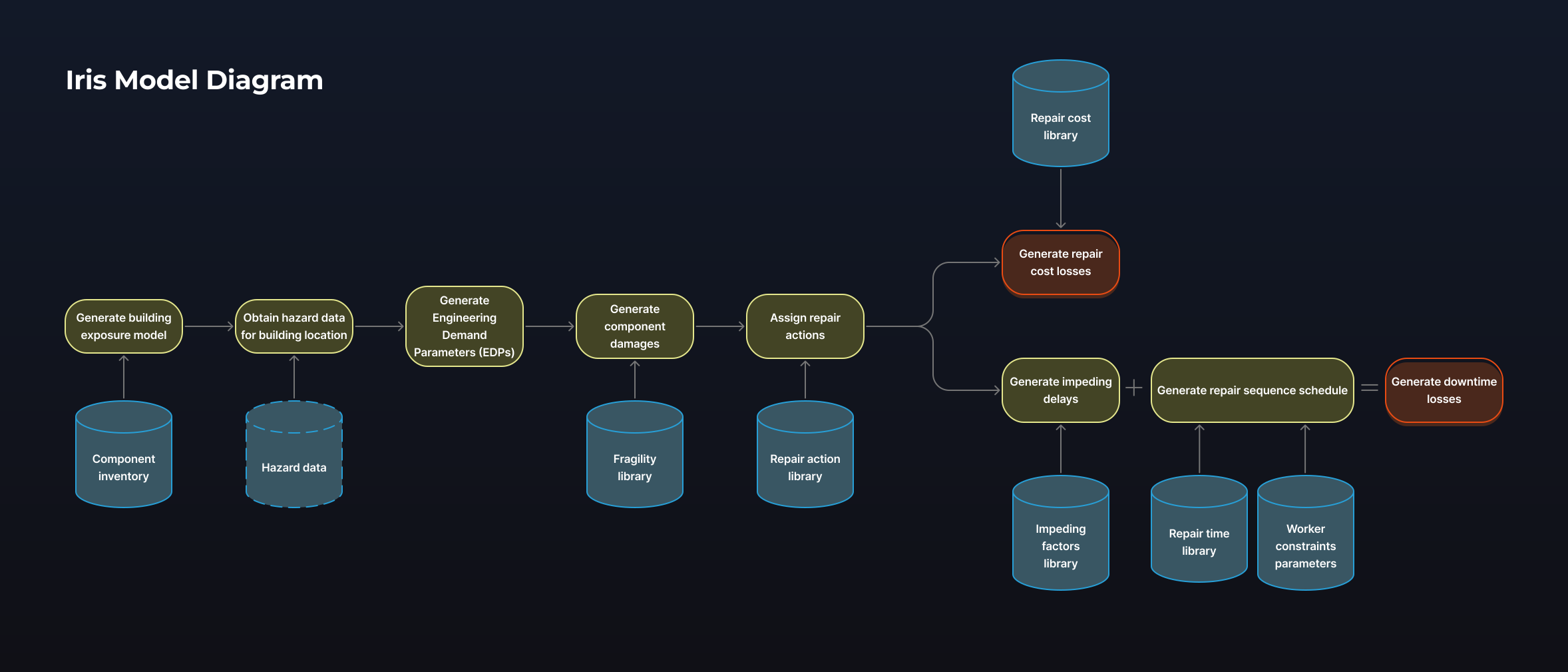
Every Iris risk model decomposes a building into its constituent systems and components, with fragility functions describing the likelihood and severity of damage given a certain hazard intensity level, and the repair actions necessary to recover. Consequence functions translate the damage into repair costs, downtime, revenue losses, and health and wellness metrics for some hazards.
Click to expand
Hundreds of building archetypes span the four core hazards (flood, wind, wildfire, seismic), covering the full range of commercial and institutional real estate. This approach has its roots in seismic performance-based engineering (FEMA P-58) and was expanded to multi-hazard application alongside the REDi guidelines developed at Arup.
Our repair cost models, downtime methodology, and consequence functions were built and refined over years of delivering resilience engineering for some of the world's largest asset owners, resulting in portfolio-wide capital programs, acquisition decisions, and physical retrofits. This is applied engineering validated by real outcomes.
Our downtime methodology, partially open-sourced in partnership with UC Berkeley's NHERI SimCenter, accounts for impeding factors (insurance financing delays, permitting, contractor mobilization), realistic repair sequences (multiple crews across systems and floors), and produces three recovery milestones: immediate re-occupancy, functional recovery, and full recovery.
In practice
When Iris shows a 100-year flood costs $470K in repairs and 150 days of downtime (50th percentile), that best estimate is built from a probabilistic range of water damage affecting specific components, at specific elevations within the building. You can trace any loss figure back to the component that generated it.
Multi-source hazard data
Iris integrates hazard data from multiple specialized providers, each selected for the hazard and geography where their data is strongest. The platform acts as an orchestrator: sourcing, normalizing, and delivering the best available hazard science for every asset-hazard pair.
13 hazards across 3 categories
Flood
Riverine
Stormwater
Coastal + Sea level rise
Wind
Cyclonic
Straight-line
Tornado
Wildfire
Earthquake shaking
Extreme heat
Extreme cold
Snow
Ice storm
Drought
Hazard data providers











Coverage spans developed and emerging markets, with resolution up to 3m in select regions (US, UK, Japan) and 30m globally. Hazard data is sampled at the building footprint, not interpolated from a regional grid.
Hazards influenced by climate change include projections using IPCC-aligned SSPs across present-day, mid-century, and end-of-century timeframes. Multiple climate models are available. The choice of scenario is driven by the decision-maker’s risk appetite and assets expected holding periods.
Hazard data is validated against known benchmarks, site conditions, and engineering judgment.
At Class 2 and Class 3, engineers review and adjust hazard inputs based on local conditions (site-specific stormwater conveyance, terrain effects, flood defense infrastructure).
Note: Iris is additive to existing catastrophe models and hazard data ecosystems.
Grounded in a framework developed at Arup
The risk class system that Iris implements was developed at Arup and published in May 2024 as A Universal Taxonomy for Natural Hazard and Climate Risk and Resilience Assessments (Buildings Edition, Version 1.0). The publication includes a foreword by Rashmin Gunasekera, senior disaster risk management specialist at the World Bank's Global Facility for Disaster Risk Reduction (GFDRR).
The taxonomy defines four risk classes (Class 0 through Class 3), each with explicit minimum criteria for hazard data, exposure data, vulnerability modeling, and output metrics. It also defines a parallel resilience class taxonomy that maps resilience solution maturity to the underlying risk class.
The taxonomy was refined through hundreds of real-world resilience engineering engagements at Arup before being codified as an open standard. Every assessment class in Iris maps directly to its specifications: data requirements, assessment approach, accuracy level, and output type.
The risk classes set the scaffolding; the engineering that fills them comes from a second Arup framework. Iris's component-by-component modeling of damage, downtime, and recovery is grounded in REDi, the resilience-based method Arup built for earthquake loss and recovery, and the platform extends that method across every hazard it covers. Iris is the software manifestation of both.
Whitepaper · May 2024
A Universal Taxonomy for Natural Hazard and Climate Risk and Resilience Assessments
Buildings Edition, v1.0 · Lead authors: Ibbi Almufti and Daniela Zuloaga (Arup)